
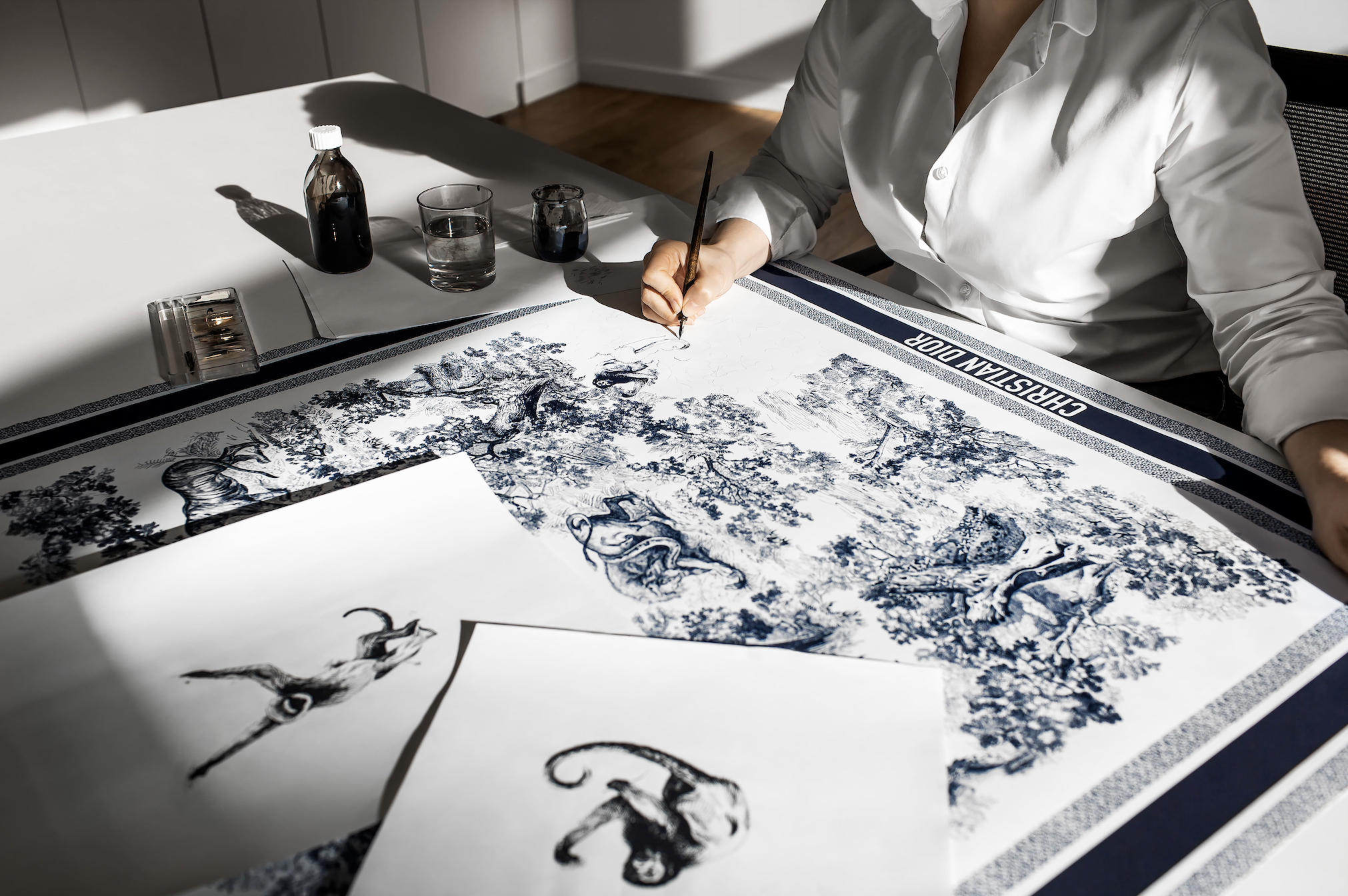
The toile de Jouy fabric is an ancestral savoir-faire, created from a practice used in the decorative arts with Indian colonial-period origins. Yet when you look at it, doesn’t it appear somewhat contemporary? Thanks to the creations of a major French fashion designer, the toile de Jouy and the house of Christian Dior share a mutual success, a success that’s made the toile de Jouy synonymous with the fashion house. The toile is a common thread uniting all the collections of Dior’s designers, from the label’s founder to his successors: Ferré, Galliano, and most recently Chiuri, all of whom have integrated the toile de Jouy into Dior’s trademark creations.
However, France banned this famous toile in 1686, when imported products from India were directly competing with the silks of Lyon. In that era, trading posts offered patterns specially created for European tastes. Due to its versatility, the toile became more and more popular throughout France and became quite famous, championed by a certain Monsieur Oberkampf, the man after whom a stop on the Parisian Metropolitan would later be named. Louis XVI would give this toile’s creator a title and Napoleon would bestow upon him the Legion of Honor. Oberkampf’s factory, established in Jouy-en-Josas, spanned different
political regimes. It eventually created history by becoming the third-largest enterprise in France. Inspired by print designs, the toile de Jouy was first stamped with a woodblock design and subsequently with a copper plaque etching.


Though its popularity would expand throughout France, it would continue to bear the name of its founding town as a point of reference. Its prints, depicting rustic, bucolic scenes – more than 30,000 of which are on inventory at the museum – were the work of skilled artists, such as Jean-Baptiste Huet. In 1947, when Monsieur Dior was refining his label’s image and seeking to personalize his Avenue Montaigne boutique with a distinguished decor, his associates steered him toward the distinguished toile de Jouy fabric. He used this to cover the entirety of his walls and furniture. Later revisited by the designer, the continually updated rustic thematics have never gone out of style, and its motif has indeed become a thing of permanence, for everything from decorative accessories to embroidered summer bags.
Through this reinvented genius, the house of Christian Dior finds its place as the keeper of the French artistic heritage it’s relied on in creating its own distinctive signature. So even if the toile de Jouy belongs to no one, it travels all over the world in the spirit of Dior, its most illustrious ambassador, on a rich tapestry comprised of all the creations that bear its name.